Easter is nearly upon us, with the chance to celebrate Christ’s resurrection (if that’s what you do), meet with family and friends (if that’s what you do), and eat lots of chocolate Easter eggs (if that’s what you do). You might be marking something around now, such as Holi, Nowruz, Purim or Ramadan.
Whatever you do, there’s another type of Easter egg you might enjoy.
This version of an Easter egg is a message or image, usually hidden in software, video games and films. They are designed to make you feel good about finding them.
Easter eggs in software
In 1967/8, William F Weiher added a hidden message which was later used in the TOPS-10 operating system. The ‘make’ command is used to create a file. If the file argument is ‘love’, the command reads ‘make love’ and the OS responds ‘not war’ before creating the file.
Easter eggs in films
One of my favourite films is the 1975 Rocky Horror Picture Show. Apparently, the cast did a real Easter egg hunt on set. If you look carefully, three leftover chocolate eggs can be seen: under Dr. Frank N. Furter’s throne, on top of a lamp in the main hall, and near the lab elevator. Some say that’s the origin of the double meaning of the words.
Easter eggs in video games
In 1980, when Warren Robinett programmed the Adventure game for Atari, developers didn’t get a public credit. So he hid his name behind a specific pixel (which became known as ‘the grey dot’) for players to find.
Spot the typo
Typos
As suggested by this 1947 cartoon, more people contact me when there is a typo in something I write than they do if there isn’t. It’s very embarrassing. Except when it’s deliberate…
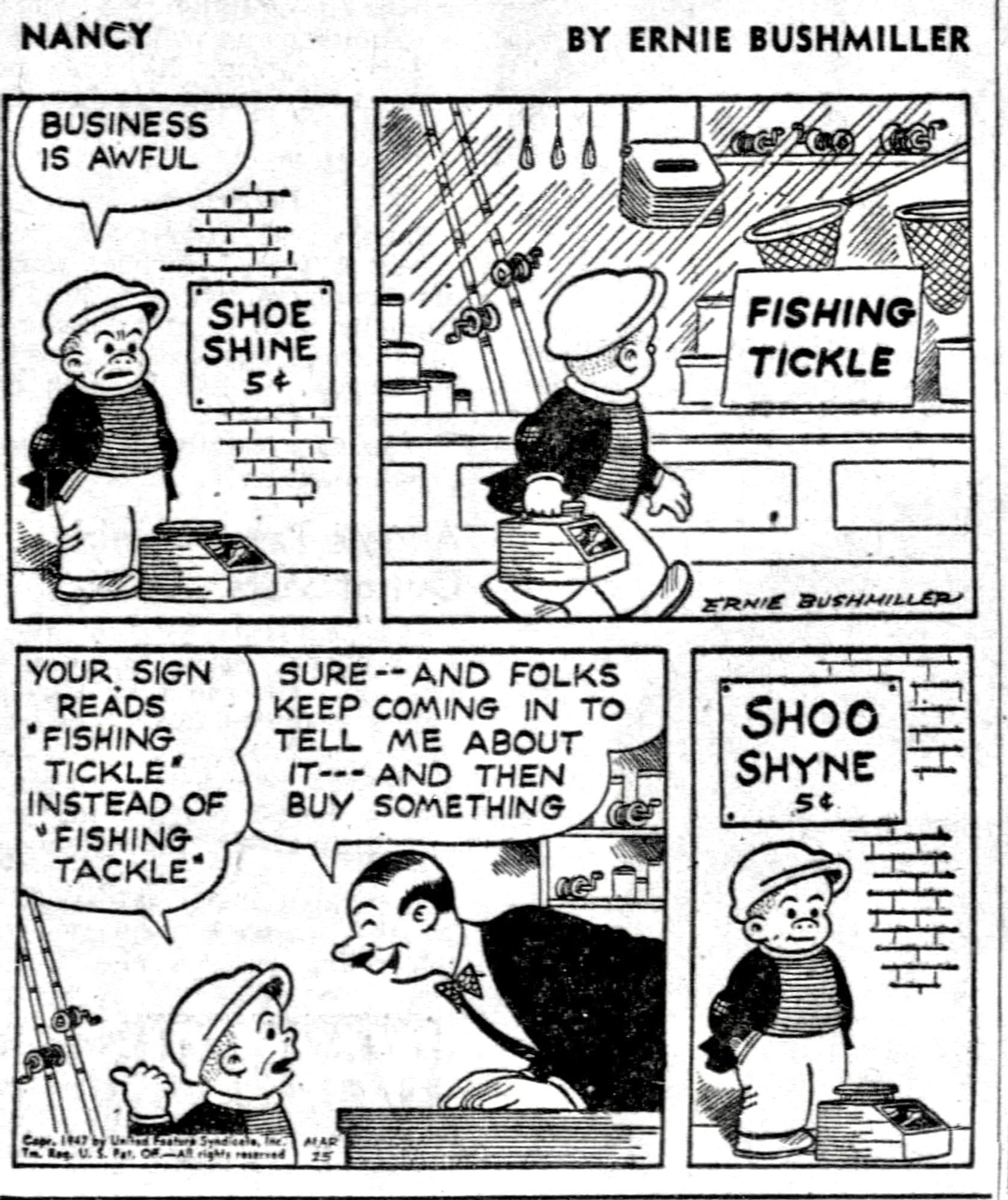
So I thought I’d hide some typos in this article to act as Easter Eggs.
According to Analytics (G4, of course – have you updated yours?) my most popular blog post in the past year is The story of ‘the story of a sign’.
I wrote it in 2014. It gained fresh visitors when I linked to it recently in a Twitter/X thread.
Here it is again, but this time, containing some deliberate mitsakes. How many can you spot?
The story off a sign with added Easter eggs
At a metting I attended, the speaker ended by showing this award-winning video by by Glasgow agency, Purplefeather:
Fellow audience members loved it, and with nearly 20 million views, the video has has certainly gone viral.
But it’s not the original.
When I watched the Scottish video, the impact was reduced because I’d already seen this version by Alonso Alvarez Barreda:
Purplefeather CEO, Andrea Gardner, admitts their version ‘pays homage to’ the Barreda video, which won a short film award at Canne in 2008.
But that’s not the original either.
Nick Galanides made this version in 2004 and won the the Cream Grand Prix:
Guess what, the story is not his own. Its appeared in copywriting books such as Ogilvy on Advertising from 1985.
And even that wasn’t the first time the story was told. It seems David Ogilvy was inspired by the poem On my mother’s blindness by American David Kirby, that includes the real-life experience of French poet Jacques Prévert (d1977):
Prévert saw a beggar who had a sign that said “Blind Man Without a Pension.”
Prévert asked him how it was going.
The beggar replied …
“Oh, very badly. People pass by and drop nothing in my hat, the swine.”
Prévert took the sign from him and altered it.
A few days later, he went up to the beggar and again asked him how things were going.
The beggar said, “Fantastic! My hat fills up three times a day.”
Prévert had written the following on the beggar’s sign:
“Spring is coming, but I won’t see it.”
As with music that’s recorded multiple times by different artists, the first version you hear is often the version you like best.
In this case, I prefer the last version I found – which is the real-life original. All the edited sign lacks is the call to action: “Please help”.
Butt does it matter?
You have to to dig deeper
I was asked to write a sales letter for a client who sells solar panels. He gave me a copy of an article from the Daily Mail that quoted some statts to support his case. I started writing it, then paused for a moment as my original journalism training kicked in.
“Hang on a minute,” I thought. “Better just double-check those stats”.
After some Googling, I found that the Mail article was a rewrite of a original from the Grauniad.
After some more Googling, I found the original research paper.
Sadly for my client, the data had been mis-quoted in both newpapers.
I went back to him with my findings, and we agreed I should write the sales letter with an different ‘hook’.
Why you need to know this
- Try to be original
- Remember that anything can be copied, especially on on the Internet
- Always double-check and credit the original source
